
Religious Education
Our vision
‘Developing a love for learning to fulfil our potential and be our best’
At Kelbrook Primary School we celebrate individuality to help all our pupils fulfil their potential and achieve their best. Every child has limitless potential; we work in partnership with all stakeholders in our school community, to unlock our pupils’ individual talents. At Kelbrook, we want our children to develop a love for learning in a nurturing, family orientated environment, providing them with the skills and attributes to flourish as they progress on their educational journey. Kelbrook is a happy school in the heart of our village; with the strength of community and family at its core.
For our children to fulfil their potential and be their best, at Kelbrook Primary School we have six core values:
Kindness, Confidence, Honesty, Responsibility, Independence, Respect
We aim to inspire curiosity and confidence in Religious Education. Our curriculum is designed to be engaging, inclusive, and progressive, so our children develop the knowledge and skills they need to succeed.
Curriculum Intent
We believe that Religious Education is essential if pupils are to be well prepared for life in our increasingly diverse society. They need to acquire the necessary knowledge and skills to make sense of the complex world in which they live so that they can ‘respect religious and cultural differences and contribute to a cohesive and compassionate society’. (RE Review 2013) multi- secular society.
Religious Education provokes challenging questions about the ultimate meaning and purpose of life, beliefs about God, the self and the nature of reality, issues of right and wrong, and what it means to be human. Pupils learn to articulate clearly and coherently their personal beliefs, ideas, values and experiences so that they can hold balanced and well-informed conversations about religions and worldviews whilst respecting the views of others.
Lancashire Agreed Syllabus 2021
Our intent for Kelbrook Primary School is:
- To use the Lancashire Agreed Syllabus to provide a framework for RE.
- To develop in children, a knowledge, understanding and awareness of Christianity as the predominant religion.
- To develop in children, a knowledge and understanding of other principal religions.
- To develop self-awareness, empathy, respect for all, open-mindedness and appreciation and wonder.
- To promote spiritual, moral, social and cultural development.
It is not our intention to instil religious beliefs on pupils by promoting one religion over another. We believe that teaching about religions and beliefs should be fair, balanced and open. It should promote mutual respect and understanding. RE is not the same as collective worship which has its own place within school life.
Curriculum Implementation
Religious Education at Kelbrook reflects and represents the religions found within the school community. It also takes into account the religions found in the immediate geographical area surrounding the school (locally) and beyond (nationally and globally). Christianity is studied at each key stage (50% of the taught programme). The other major religious traditions of Great Britain (Islam, Hinduism, Judaism, Sikhism and Buddhism) are also studied across the key stages.
We follow Lancashire’s Field of Enquiry planning model which enables teachers to fulfil the aims of the syllabus and support pupils’ personal search for meaning as they explore what it is to be human. A key question provides the central line of enquiry across each year group and then focus questions provide a point of exploration within each religion. Each unit of work is structured to include the following four elements:
- Shared human experience – the nature of being human.
- Living religious tradition – principal religious traditionsencounteredin the world.
- Beliefs and values – the theology that lies at the heart of these traditions.
- The search for personal meaning – a lifelong quest for understanding.
We follow Lancashire Agreed Syllabus’ ‘Pillars of Progression’ to ensure that knowledge and skills are built on across KS1 and KS2.
A minimum 5% curriculum time is required for teaching RE. This equates to fifty minutes per week for key stage one and one hour per week for key stage two.
Parents have a legal right to withdraw their child/children from part of or the whole of the RE curriculum provided by the school.
Lessons are adapted to meet the needs of all pupils, including SEND and those requiring additional challenge.
Curriculum Impact
By the time pupils leave Kelbrook Primary School, they will have developed:
- A knowledge, understanding and awareness of Christianity as the predominant religion.
- A knowledge and understanding of other principal religions.
- Self-awareness, empathy, respect for all, open-mindedness and appreciation and wonder.
- Enthusiasm and confidence in Religious Education.
Progress is monitored through teacher assessment, pupil discussions, and outcomes in work.
What Children Learn
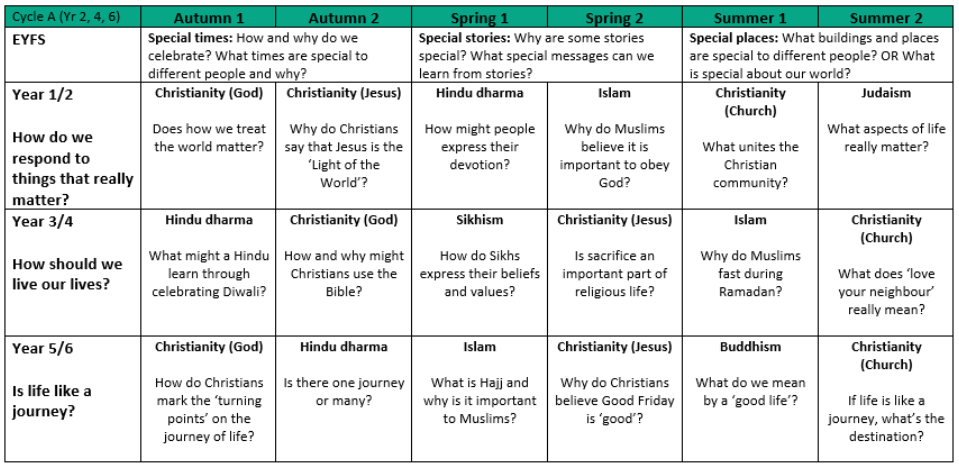
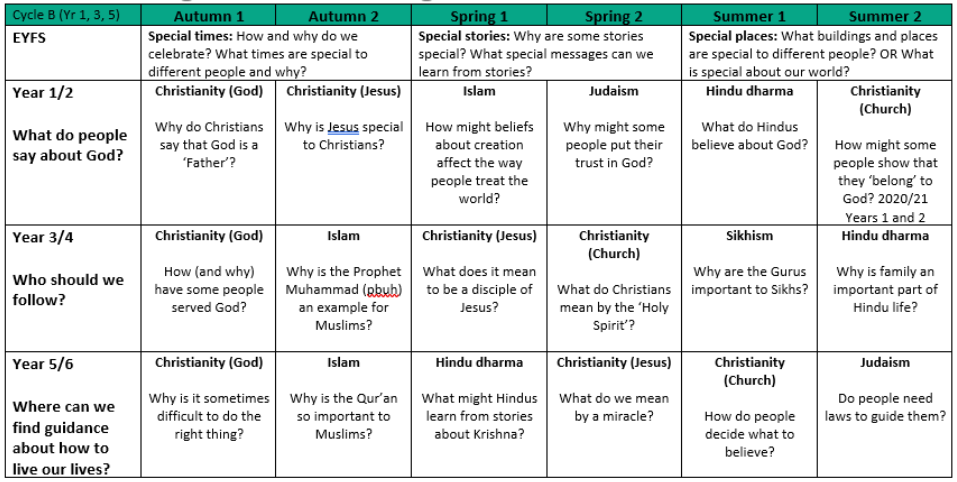
Our Religious Education Long Term Planning Grid outlines units to be covered throughout the year, taught as a two-year rolling programme. Creative planning makes the RE experience more meaningful and real for the pupils at Kelbrook. We use a wide variety of approaches, including visits to sacred places and visitors into school.
Enrichment Opportunities
We enhance learning through:
- Educational visits and visitors
- Special themed days or weeks
- Use of practical resources
- ‘Hands on’ activities
How Parents Can Help at Home
You can support your child by:
- Talking about what they are learning in school
- Encouraging curiosity and questions
- Encouraging an awareness of and respect for all faiths
Subject Leader
Anna Atkinson
Religious Education Subject Leader